

Networking Doesn’t Have to Be So Awkward
A few weeks ago, I was coaching a client who was preparing to attend a conference. He was excited about the event, but also nervous.
Like many people, he wasn't worried about the sessions or the travel logistics. He was worried about the networking.
What if I don't know anyone? What if I don't know what to say? What if I feel awkward standing by myself? How do I make the most of the experience?
If you've ever attended a conference, networking event, chamber gathering, or industry meeting, you've probably had similar thoughts.
Around the same time, I found myself leading a conference workshop called The Non-Awkward Networking Workshop. To kick things off, I asked participants a simple question:
What are the first three words that come to mind when you think “Networking Event”?
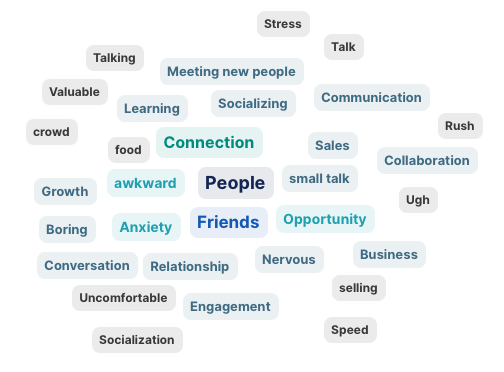
The 122 responses were telling...
Of all the responses, at least one-third suggested a less-than-desirable feeling toward networking: stress, awkward, anxiety, boring, and my personal favorite, ugh.
On the bright side, the majority of responses had a positive tone. Still, it was clear that networking brings up mixed emotions for many people.
In other words, my client wasn’t alone.
Here’s the common theme I see: most people recognize the value of networking, but many don't actually enjoy it.
The good news? Networking doesn't have to feel so uncomfortable.
One of the biggest networking lessons I've learned is this:
A little preparation combined with a little less focus on yourself creates a much better networking experience.
When we stop thinking about how we're being perceived and start focusing on the other person, everything changes. Conversations become easier. Real relationships begin to form. And opportunities surface more naturally.
The most effective networkers aren't necessarily the most outgoing people in the room. They're often the people who are genuinely curious, generous, and interested in helping others.
Instead of thinking about networking as collecting business cards or delivering the perfect elevator pitch, think about it as building meaningful connections one conversation at a time.
Here are a few practical networking tips to help.
10 Practical Networking Tips
1. A little prep work goes a long way.
The more prepared we feel going into something, the less anxious we tend to be.
Spend a few minutes researching who will be attending the event, then identify people you'd like to meet. This may include specific names if you know that level of detail about the audience. If not, it can be more general: I'd like to meet someone who works in this industry, serves in this role, or works for this company.
Taking a little mystery out of the experience reduces stress. Identifying people you'd like to meet creates anticipation and excitement instead of dread.
2. Set a simple goal.
Rather than trying to "work the room," set a specific goal for the event. This gives you focus and a sense of control.
Here are a few ideas:
Meet three new people
Reconnect with one old contact
Connect two people who could possibly help each other
Practice your introduction
Share a helpful resource
Once you've achieved your goal, you're free to leave if you'd like. This encourages you to fully engage while also giving yourself permission to step away when you've accomplished what you came to do.
3. Invite someone to join you.
Who else could benefit from this event? Or who would make a good wingman or wingwoman?
Attending with someone you know creates an immediate sense of belonging, which often boosts confidence and makes it easier to meet new people.
4. Plan your outfit.
I once attended a childhood friend's wedding in San Francisco. I'm from Boise, where people show up to weddings in quite the range of attire—from jeans and cowboy boots to suits.
I wasn't dressed poorly, but I was definitely underdressed, and it made me feel uncomfortable all night.
Don't make my mistake.
If you're already anxious about mingling, the last thing you need is to worry about how you look. Do a little homework and show up in something that helps you feel confident and comfortable.
5. Prepare a few opening questions.
One of the easiest ways to reduce networking anxiety is to prepare a few conversation starters ahead of time.
Try questions like:
What brought you to this event?
Which speaker or session are you most excited about?
What kind of work do you do?
How did you get started in your field?
What trends are you noticing in your industry right now?
You don't need a perfect script. You just need a place to start.
6. Focus on making others comfortable.
One of the best ways to reduce your own nervousness is to focus on someone else's comfort. Go find the person who is standing alone or looks like they’re feeling uncomfortable. Make them feel at ease.
Smile. Be fully present and engaged. Lean in. Help people feel seen, heard, and valued.
The more you focus on making others feel comfortable, the more at ease you'll feel yourself.
7. Lead with curiosity.
The best networkers are often the best question-askers.
You don't need to have brilliant things to say about yourself. People are far more likely to remember how you made them feel than the details of your resume.
Ask thoughtful follow-up questions and genuinely listen to the answers.
When someone shares something interesting, build on it: "Oh, that's interesting. I'd love to hear more about that."
Curiosity creates connection.
8. Share context, not just facts.
Stories create connection. Instead of giving one-word answers, offer a little background and personality.
For example, if someone asks how I heard about an event, I could simply say:
"A friend told me about it."
Or I could say:
"My friend Megan told me about it. Megan and I worked together on a fun design project for a local client last year, and then we actually started running together once a week as well. She mentioned this event during our run last Saturday."
Now the other person has multiple opportunities to connect—design projects, local business, running, mutual connections, and more.
The more context you provide, the more opportunities there are for meaningful conversation.
9. Be a connector.
Some of the most valuable networkers aren't the best self-promoters. They're the people who connect others.
Listen for opportunities to introduce people, share resources, or point someone toward a helpful contact.
People remember those who create value for them.
10. Follow up with care.
The end of the event is not the end—it's the beginning.
Send a LinkedIn connection request. Share a relevant article. Make an introduction. Thank someone for the conversation.
Don't let the time and energy you invested in meeting people go to waste. Relationships grow through follow-up.
One final reminder: the best networking doesn’t happen only at networking events.
It happens at your child's soccer practice, at neighborhood gatherings, at community events, in volunteer organizations, and even while standing in line for coffee.
The good news is that networking gets easier with practice. Every conversation is an opportunity to learn, serve, and build a relationship.
The goal isn't to impress people.
The goal is to leave people feeling seen, valued, and connected.
When you do that consistently, the business opportunities tend to follow.